


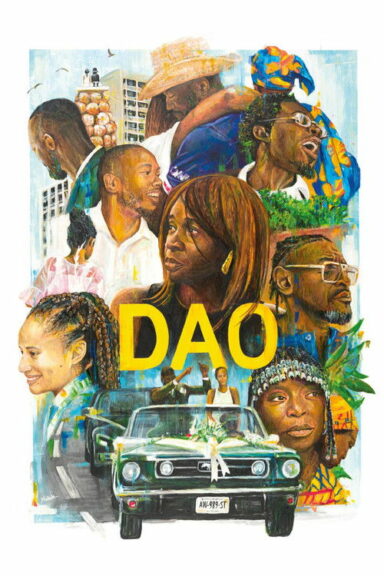
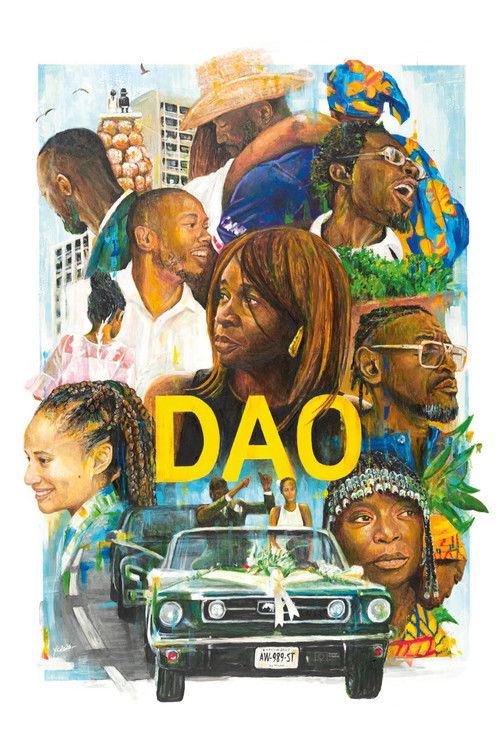

A film by Alain Gomis
With: Katy Correa, D’Johé Kouadio, Samir Guesmi, Mike Etienne, Nicolas Gomis, Fara Baco Gomis, Poundo Gomis
A family weaves the threads of a heritage that travels between worlds. Joy and pain, memory and transmission. A wedding in France, a commemorative ceremony in Guinea-Bissau. Two celebrations, organically intertwined through bodies and time, leading to a rebirth.
Our rate : ★★
With Dao, Alain Gomis returns to compete in Berlin nine years after winning the Silver Lion with Félicité. Dao is not lacking in ambition, attempting to tackle a philosophical question that is both simple and complex: the dao, commonly defined as a fundamental essence that flows through all things in the universe, living or inert, and which forms the basis of reality. Gomis takes care to reveal his intention right from the opening of the film, just as he openly decides, in a fairly long video montage sequence, to reveal his process to the viewer, keeping on screen a few juxtaposed shots from behind the scenes of the film, whether casting tests or preparatory moments. His process consists more precisely, as he explains in a press conference, of bringing together professional and non-professional actors, giving them a framework, and then trusting not their improvisation, but their embodiment of their roles, what they bring to the film, once they have grasped the framework designed for them. Samir Guesmi also mentions this rather unsettling process: a few lines were prepared, but during filming, he didn’t know exactly when would be the right moment to slip in the text, stick to it, or deviate from it. He lived in the moment as if it were the present. Only 10 days of filming in Guinea, 10 days of filming in France, for two ceremonies that marked the starting point of this experimental project: a wedding in France, bringing together an extended family, friends, and acquaintances, and a very different ceremony in a reconstituted family (a mix of real family and in-laws) commemorating the death of a patriarch in Guinea. The starting point for the film, Gomis admits that the idea came to him during his father’s funeral. The camera therefore seeks to capture universal truths that go far beyond what Gomis himself could see or sense, with each performer bringing their own personal touch, exaggeration or restraint, or even their own point of view. In this way, the film questions very universal themes, such as family, culture, life, death, our relationship with the dead, our relationship with others in general, but also integration into a culture, being a stranger to one’s own culture, and the search for a soul mate and love. In itself, the process and the camera do indeed succeed in bringing out, at times, unfathomable truths, leaving the observer (the viewer) to find their own way between two disturbing reconstructions, which are fictional but close in form to a documentary, particularly in the African section, which gives prominence to tradition, rituals, and communication with the dead. In this respect, the film achieves its goal, aided by a narrative editing technique that uses horizontal (from one ceremony to another) and vertical (back and forth in time) shifts. It is equally successful in its more political endeavor, which, as Gomis so aptly puts it, should encourage all Africans to be proud of being African, not to feel guilty about their culture, beliefs, and traditions, when the Western way of life is just as irrational and unacceptable (taking the example of the ritual sacrifice of a cow during the ceremony, which is no more violent or cruel to animals than the livestock industry in France). The whole thing would be brilliant if Gomis had not fallen into the pitfalls inherent in his approach. In his eagerness to let the camera capture the real moment, he ends up capturing background noise, repetitions, hesitations, and procrastination. The framework of the ceremonies and the obligatory passages certainly provide structure, but here too, a double effect arises, that of a return to abrupt, accelerated, almost unreal fiction, counterpointed by overly drawn-out, spinning shots.